Tuesday, July 20, 2010

Student activity at University of New Orleans

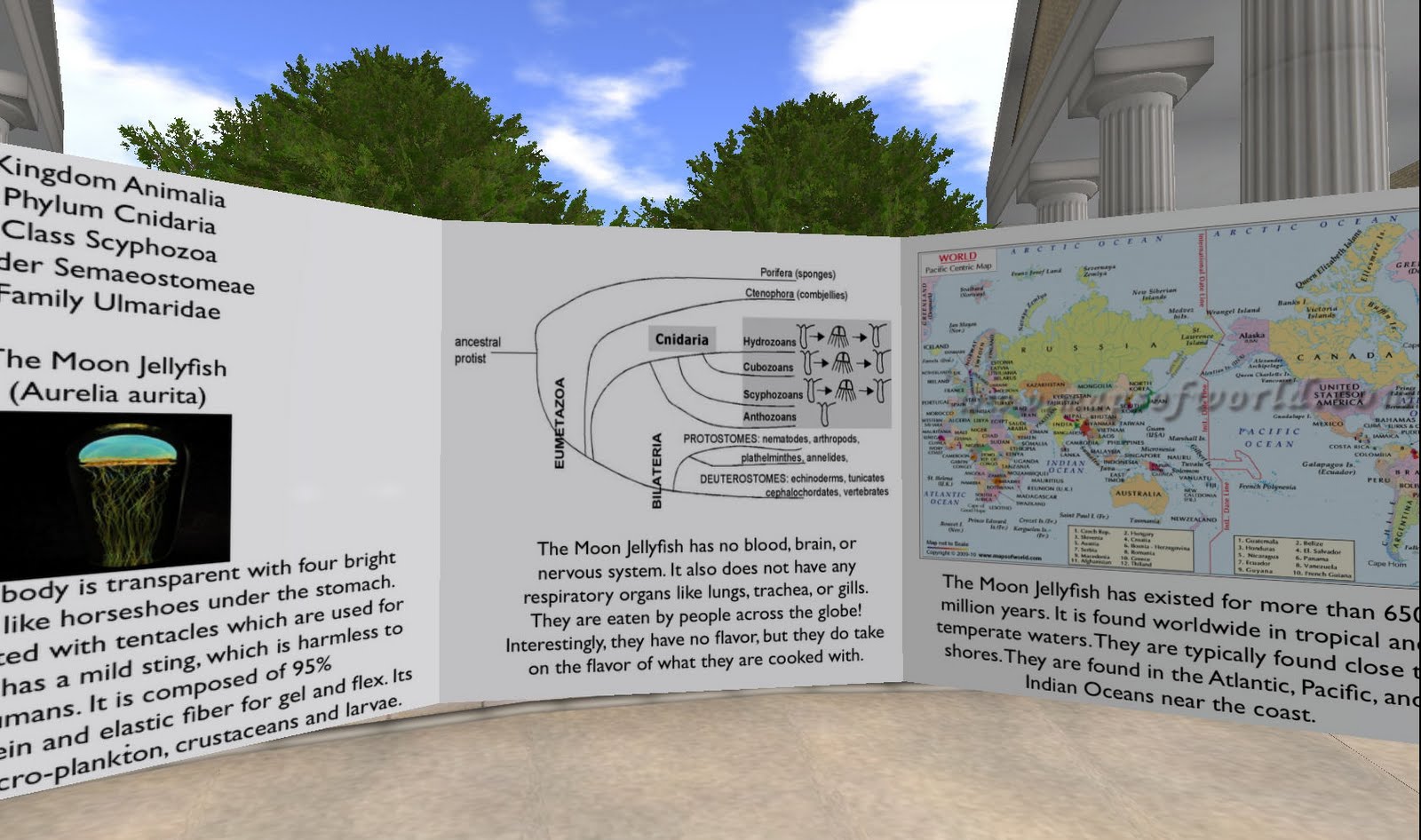
Today I visited the University of New Orleans in Second Life, where Stephen Gasior (SL Stephen Xootfly) showed off his student's work in Second Life. The assignment was to select an animal and in the space of a three panel display present information about the animal's natural history, classification and phylogeny and distribution. These students are in a non majors class and did a fine job with their assignment. So you might go on over to the University of New Orleans region and have a look. You can start your tour and get a map here:

http://maps.secondlife.com/secondlife/Louisiana%20Regents/53/60/25

But it's just as much fun to wonder around. Here are a few representative displays:


I really liked how he kept the assignment simple and focused-no building was required of the students but they did have to design their own layouts. Steve brought in judges-yours truly was supposed to be one but of course misread the starting time.

Great job students!

Friday, July 2, 2010

An SL Biology Event-call for volunteers

I just received a note from a Biology professor who is asking for volunteers to help access from student projects in Second Life.

Stephen Gasior(SL=Stephen Xootfly) writes:

Dear Biologists-

Hi. I am teaching a nonscience majors biology class in Second Life this summer. I am having my students make a presentation board about an animal. Basically 3 static textures. I am going to grade the content, but I would like to have biology faculty come talk to them about it. You can also note that they seem to know what they are talking about and confirm that they did the work. In other words, if you can tell me whether they should pass/fail the assignment.

Preferably, I would like to have other university or college faculty with a background in biology. If you would like to volunteer, please send me a link to your faculty profile page.

The event will take place in SL on Tuesday July 20th from 12:40 to 1:40 CST (10:40 to 11:40 SLT). If you are interested in helping me out, please let me know. By July 15th. Location will be on the Louisiana Board of Regents Island (look in my profile).

Thank you.

Stephen Gasior
sgasior@uno.edu

Stephen Xootfly in SL

Sounds like fun and its on a Tuesday when I am not teaching.

Thursday, May 20, 2010

Been Kind of Busy with First Life

Well some first life projects took over for about a month...but finally the semester is just about over. Yesterday I, or rather my meat avatar, met with the our IT people about refreshing our colleges's island to accommodate projects and make the island easier to use (yea!).


So to ease back into SL, I decided to revamp my JCCC office to make it cleaner in appearance, cut down on prim use turn it into more of a floating residence. This is because we are going to flatten the topography and I want my ground space free for my evolution critters.

Speaking of which now I can get back to that project. Yea!

Tuesday, March 23, 2010

Evolution Simulation IV: Mutating critters at last!

As noted in my last post I was finding all sorts of problems with my region. Turns out that these were due to two things. First to control my critters I was killing them off bu broadcasting a commmand that triggers the llDie() function. But too many prims dying at once was messing up the asset server.

Also I was duplicating the critters en mass and that I led the server to treat my critters as the dreaded grey goo. Grey goo is a term for excessive rapid self replicating prims. See this discussion of the origin of the term from nanotechnology. When Second Life, and apparently OpenSim as well, detects too rapid prim replication this is treated as grey goo and a defense against this called the grey goo fence is activated.

Open Sim apparently doesn't warn you about this and I only discovered the problem when experimenting with my critters in Second Life. Second Life does warn you about grey goo and I got the warning rezzing even a small number of critters at once. Apparently the limit is about 240 rezzings in 6 seconds. Beyond that the ability to rez those prims is restricted. My inadvertant experiments suggest that in SL the limit may be more stringent than 240 rezzings in 6 seconds.

See http://lslwiki.net/lslwiki/wakka.php?wakka=GreyGooFence for a discussion of Grey Goo and the Grey Goo Fence.

This last week I worked out how to input and represent the critters genetics and the mutation routines. In my earlier systems I had the critters read their initial genetics from a note card. Instead I use the object description field to enter and store the genetics as a string of integers.

Right now the description field has 4 digits

position 1 = "1" or "2" "1" = haploid "2" = diploid. Right now the critters are strictly haploid so this position is ignored for now.

Position 2, 3, 4 are three loci each with 9 possible alleles represented by single character "0" through "9". For the haploid critters, this means there are 1,000 possible genotypes.

Since I mean my evolution simulation to be visual the genotypes in the three loci are used to make a vector that can be used with the llSetColor function.

So in the object description field the legitimate genetic description would be
"1045" . When a new critter is rezzed, the description can be passed to the offspring through the parameter in the llRezObject function.

I also wrote a mutation function:

string mutation(string start, float mforward, float mback)

Where the string is the genetic description, mforward and mback are forward and back mutation rates going forward to the next allele and mback the back mutation rate to the previous allele. So I assume if the allele is "7" then forward mutation would lead to a change to "8", and back would change from "7" to "6".

In addition another function setcolor(string thedata) takes the genetic string, isolated the loci and uses them to set the color of the critter and display the genetic description as using llSetText. I did this because just as in real populations most of the genetic variation leads to subtle variation in the population phenotypes over the short run.

The image shows the results. The critters started out with the color <.9, 0 .9> which sort of a light bluish green. After 4 generations of mutations if you look at the image you can see subtle differences resulting from successive mutations.

The critters still don't really interact with each other and wander around randomly, but not leaving my region. I did some work streamlining this routine so it was much more efficient.

Next up....adding simple natural selection to the mix.

Monday, March 8, 2010

Evolution Simulation III Devastation in Science Sim!

Well not quite. But I was testing my critters to see how big a population my parcel in Science Sim could hold. Everything was fine until I went to delete them using a listen event with llDie triggered by a chatted command. Guess what, 600 prims dying all at once causes the asset server to have a fit: a bit disconcerting but Mic Bowman got things fixed....


And immediately after Mic's fix:


Thigs were still loading at this point. What Mic recommended is that I use a random number to determine when a particular critter is going to die so that when I issue the command to die the critters don't all die at once.

In SL this bit of code gives a quite realistic movement for my critters:

vector newpos = newcoodinates(llGetPos() ,3.0);

llSetRot(llEuler2Rot(<0,0,-pi/2>)*llGetRot());

llLookAt(newpos,1,0);

llSetPos(newpos);


But in OpenSim the critters don't seem to turn toward the target in response to llLookAt as they do in SL.


Thursday, February 25, 2010

SLPro Conference Day 3 Invasion!

Just down the road from my project is this collection of marvelous insects made with scupted prims...and they are flyable according to the menu options. But I guess you have to be the owner to fly them.


The Dragonfly is spectacular!


The builder by the way is Strat Inshan.

Wednesday, February 24, 2010

SLPro Conference Day 2

My humble entry into the Shared Media competition.

Don't expect to win the $L 10,000 but I had fun putting together a little chi square demo showing how Google's Spreadsheet can be used on a prim. The hard part was working around the limitations of Google's Spreadsheet.

Sorry Google, you may be taking over the world but you ought to spend some time improving your spread sheet especially protections. I can't believe your programmers couldn't figure out how to protect just part of a spreadsheet!

I finally figured out that I can protect my original spreadsheet and have people access it and copy it and just work with the copy.

Grrrrrr......