Showing posts with label Biology. Show all posts

Thursday, August 8, 2013

A Tide Pool in Kansas?

Ocean life has always held a fascination for me, something I suspect is not uncommon among those of us who end up as biologists. My mother gave me some of Rachel Carson's books, the The Sea Around Us, The Edge of the Sea and several trips to Cape Cod imprinted the smells, sites and creatures of the sea. So of course as part exploring Blender and mesh had to make something with tentacles. I didn't think I was ready to tackle squid or octopuses so decided on sea anemones. Easy enough right...well it took 2 days to get something that looked sort of like a sea anemone.

Here are three of my attempts. My first attempt is on the left and my latest attempt is on the right.


 The first attempt was not meant to be realistic and I had all sorts of trouble with painting the seams out. Both the second and third attempts are more realistic, which ironically was easier than what I tried to do in my first attempt.  The tentacles were done using extrude, scale and translate tools in the mesh editor. There are I think other ways to do tentacles but I decided to stick with the the tools I best understood. The last one is still has some seam issues but pretty minor.

Of course I had to make my own little tide pool. Which resides some where in the cloud or mirrored to my home machine, alas in-silico.

Tuesday, July 20, 2010

Student activity at University of New Orleans

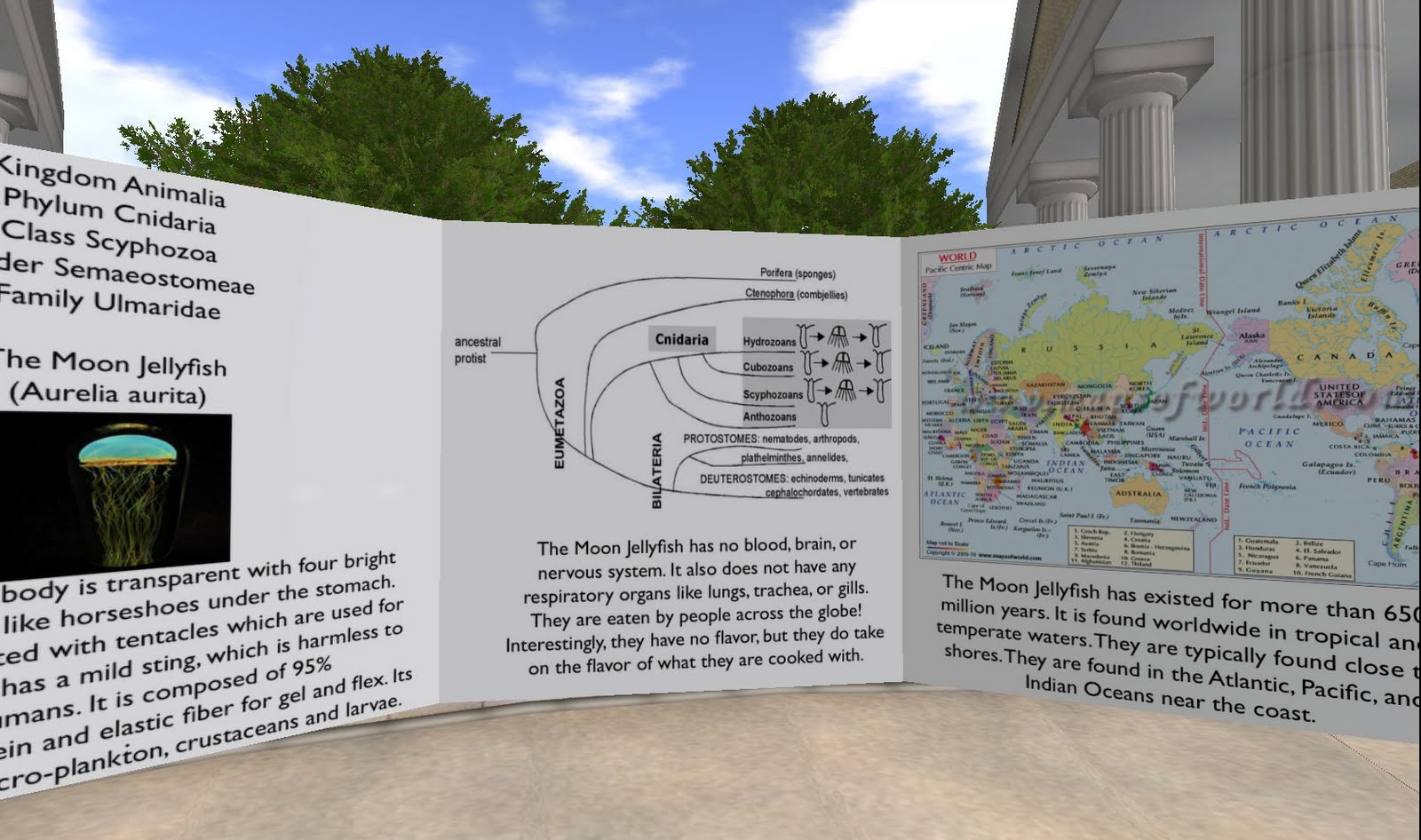
Today I visited the University of New Orleans in Second Life, where Stephen Gasior (SL Stephen Xootfly) showed off his student's work in Second Life. The assignment was to select an animal and in the space of a three panel display present information about the animal's natural history, classification and phylogeny and distribution. These students are in a non majors class and did a fine job with their assignment. So you might go on over to the University of New Orleans region and have a look. You can start your tour and get a map here:

http://maps.secondlife.com/secondlife/Louisiana%20Regents/53/60/25

But it's just as much fun to wonder around. Here are a few representative displays:


I really liked how he kept the assignment simple and focused-no building was required of the students but they did have to design their own layouts. Steve brought in judges-yours truly was supposed to be one but of course misread the starting time.

Great job students!

Friday, July 2, 2010

An SL Biology Event-call for volunteers

I just received a note from a Biology professor who is asking for volunteers to help access from student projects in Second Life.

Stephen Gasior(SL=Stephen Xootfly) writes:

Dear Biologists-

Hi. I am teaching a nonscience majors biology class in Second Life this summer. I am having my students make a presentation board about an animal. Basically 3 static textures. I am going to grade the content, but I would like to have biology faculty come talk to them about it. You can also note that they seem to know what they are talking about and confirm that they did the work. In other words, if you can tell me whether they should pass/fail the assignment.

Preferably, I would like to have other university or college faculty with a background in biology. If you would like to volunteer, please send me a link to your faculty profile page.

The event will take place in SL on Tuesday July 20th from 12:40 to 1:40 CST (10:40 to 11:40 SLT). If you are interested in helping me out, please let me know. By July 15th. Location will be on the Louisiana Board of Regents Island (look in my profile).

Thank you.

Stephen Gasior
sgasior@uno.edu

Stephen Xootfly in SL

Sounds like fun and its on a Tuesday when I am not teaching.

Thursday, May 20, 2010

Been Kind of Busy with First Life

Well some first life projects took over for about a month...but finally the semester is just about over. Yesterday I, or rather my meat avatar, met with the our IT people about refreshing our colleges's island to accommodate projects and make the island easier to use (yea!).


So to ease back into SL, I decided to revamp my JCCC office to make it cleaner in appearance, cut down on prim use turn it into more of a floating residence. This is because we are going to flatten the topography and I want my ground space free for my evolution critters.

Speaking of which now I can get back to that project. Yea!

Tuesday, March 23, 2010

Evolution Simulation IV: Mutating critters at last!

As noted in my last post I was finding all sorts of problems with my region. Turns out that these were due to two things. First to control my critters I was killing them off bu broadcasting a commmand that triggers the llDie() function. But too many prims dying at once was messing up the asset server.

Also I was duplicating the critters en mass and that I led the server to treat my critters as the dreaded grey goo. Grey goo is a term for excessive rapid self replicating prims. See this discussion of the origin of the term from nanotechnology. When Second Life, and apparently OpenSim as well, detects too rapid prim replication this is treated as grey goo and a defense against this called the grey goo fence is activated.

Open Sim apparently doesn't warn you about this and I only discovered the problem when experimenting with my critters in Second Life. Second Life does warn you about grey goo and I got the warning rezzing even a small number of critters at once. Apparently the limit is about 240 rezzings in 6 seconds. Beyond that the ability to rez those prims is restricted. My inadvertant experiments suggest that in SL the limit may be more stringent than 240 rezzings in 6 seconds.

See http://lslwiki.net/lslwiki/wakka.php?wakka=GreyGooFence for a discussion of Grey Goo and the Grey Goo Fence.

This last week I worked out how to input and represent the critters genetics and the mutation routines. In my earlier systems I had the critters read their initial genetics from a note card. Instead I use the object description field to enter and store the genetics as a string of integers.

Right now the description field has 4 digits

position 1 = "1" or "2" "1" = haploid "2" = diploid. Right now the critters are strictly haploid so this position is ignored for now.

Position 2, 3, 4 are three loci each with 9 possible alleles represented by single character "0" through "9". For the haploid critters, this means there are 1,000 possible genotypes.

Since I mean my evolution simulation to be visual the genotypes in the three loci are used to make a vector that can be used with the llSetColor function.

So in the object description field the legitimate genetic description would be
"1045" . When a new critter is rezzed, the description can be passed to the offspring through the parameter in the llRezObject function.

I also wrote a mutation function:

string mutation(string start, float mforward, float mback)

Where the string is the genetic description, mforward and mback are forward and back mutation rates going forward to the next allele and mback the back mutation rate to the previous allele. So I assume if the allele is "7" then forward mutation would lead to a change to "8", and back would change from "7" to "6".

In addition another function setcolor(string thedata) takes the genetic string, isolated the loci and uses them to set the color of the critter and display the genetic description as using llSetText. I did this because just as in real populations most of the genetic variation leads to subtle variation in the population phenotypes over the short run.

The image shows the results. The critters started out with the color <.9, 0 .9> which sort of a light bluish green. After 4 generations of mutations if you look at the image you can see subtle differences resulting from successive mutations.

The critters still don't really interact with each other and wander around randomly, but not leaving my region. I did some work streamlining this routine so it was much more efficient.

Next up....adding simple natural selection to the mix.

Thursday, February 25, 2010

SLPro Conference Day 3 Invasion!

Just down the road from my project is this collection of marvelous insects made with scupted prims...and they are flyable according to the menu options. But I guess you have to be the owner to fly them.


The Dragonfly is spectacular!


The builder by the way is Strat Inshan.

Thursday, February 4, 2010

OpenSim Evolution Simulation I

This is the first progress report on what's going on with my OpenSim Artificial Life/Evolution simulation introduced in this post.

Since I am interested in social behavior I think a good place to start is simulating a population where prisoner's dilemma is operating. The term "game" here used in the game theoretic sense, gets its name from the following scenario:

Two suspects are arrested by the police. The police lack enough evidence for a conviction. The prisoners are kept separate and the prosecutor visits each of them with the same deal. If one testifies (defects from the other) against the other, and the other remains silent (cooperates with the other prisoner), the betrayer goes free and the silent accomplice receives the full 10-year sentence. If both remain silent (they cooperate with each other), each gets only six months in jail for a minor charge. If each betrays the other, each receives a five-year sentence. Each prisoner must choose to betray the other or to remain silent. Each one is assured that the other would not know about the betrayal before the end of the investigation.

(modified from http://en.wikipedia.org/wiki/Prisoner%27s_dilemma)

Now this scenario may not seem related to evolution but it turns out that this is exactly the sort of thing that happens when two animals related or not might have choices to cooperate or not with other animals either of the same species or sometimes other species.

A couple of design issues revolve around topics like how to link the organisms' behavor to genetics, represent the genetics of the interacting organisms and how to pass that genetics to offspring. To get a feel for the general strategy I have used in the past, go to this post.

One new technical issue is that unlike my genetics activities and my discrete generation evolution simulation, the organisms I am using here have to be able to replicate themselves independently of some command from me. Now that a scary thought since I don't want to over run a sim with thousands of little evolving critters.

Fortunately the LSL Wiki gives a good rundown on how to make non invasive self replicating critters. For instance have them be killed if they get out of your parcel. Right now my critters are able to detect the parcel boundary and turn away from the boundary....but I will add the kill feature as an additional safety.

One of LSL's safety features isn't going to work in my case. LSL recommends using a counter that is decremented by 1 each time an offspring is replicated from the parent. The value of the counter is passed as the integer parameter in the llRezObject function and when the counter reaches zero say after 10 generations the critter dies rather than replicating. The problem is that I use this parameter to pass the genetics from parent to offspring.

So I need to figure out how to prevent non invasive critters from over running my parcel. My first impulse was to have each critter sense the number of critters in the parcel and stop them from replicating when the parcel count gets to a certain point-kind of a parcel carrying capacity. And that might be a good idea but the simplest way to do it might be to have one object track the number of critters in in the parcel and periodically send that to all the critters using llRegionSay on a private channel and have the critters individually adjust their replication as required.

A more interesting option might be to use a sensor event to get the number of critters in a set radius around the sensing critter and use that to adjust the rate of reproduction, perhaps make it negative. So critters in a region with few others would be able to multiply more rapidly than those at higher densities. I already use a sensor event to let the critters detect each other so I could modify that to do this as well. This would actually be quite realistic since organism's reproductive rates are often affected by density dependent factors.

So here is what I am thinking on the replication issue:

1. Implement a die if beyond land owned by me along with my current boundary detection routine.
2. Implement a central controller that determines how many critters are in my region and either kills them all or stops them from reproducing further if they get too numerous beyond some large population size say 4,000.
3. Implement the sensor option to determine the density of critters and adjust the rate of local reproduction. Should be possible to tweek this so the population's maximum would tend to run at a lower limit than 4,000, say 2,000.

Maybe I am being paranoid but who knows what sort of chaotic things can happen with 2,000 artificial life forms run around a sim unchecked. It would be the equivalent of pythons in the Everglades and probably really annoy my neighbors.


This may be interesting in its own right as a simple population growth model even with out the complication of prisoner's dilemma! If you want to join the fun and see what's going on, IM me as Paul Decelles in ScienceSim or as Simone Gateaux in SL . Remember, you need to configure your client for OpenSim and set up a user account. Also Avatars do not port between SL and Opensim.

The ScienceSim site will get you started.: http://www.sciencesim.com/ Make sure you read and follow the directions and rules carefully.

PS: SLurls don't work in OpenSim as far as I can tell but if you are in OpenSim I am in
Oregon North 47, 184, 23 in the ScienceSim grid.

Tuesday, July 21, 2009

Mitosis I Wigglies


Animated and wiggly duplicated chromosomes (Reddish wormie things*) scripted to separate and behave as they do during anaphase. The green structures are the paired centrioles, the pink box when touched tells the sister chromatids...those are the wigglies... to separate into unduplicated chromosomes.

*notice the precise biological terminology in this post.

Thursday, June 4, 2009

Particle fun

In building my protein synthesis model, I really don't want to use more prims than needed. At the same time I want to display the results in a more interesting way than than as a string. So I have been playing with a particle system.

Here's the result. The script is modified from a snippit of script that generates a particle banner by Debbie Trilling, part of her Random AV profile script.

I tweaked those settings to give two functions that collectively take a text string and converts it into a string of particles. One could use this to display text messages, but here I am using it to display the one letter amino codes of a proteins primary structure. The colors represent the type of amino acid (non polar, acidic, polar non ionizing etc). Of course you have to put a texture for each symbol.

The two functions I developed to represent the protein's primary structure as a string of particles

particleletter(string texture, float distance, float size)


particlemessage(string message, float distance, float size, float speed)

This system unfortunately does not work reliably in that the individual particles are not always produced so the display will have gaps in it. This is a big problem with long polypeptides such as this one here which is the primary structure of an opsin protein.

Another limitation is that the particles only last for a minute or so.

For the student version I will use a small polypeptide with 10-12 residues, that way the DNA template and RNA will require only 30 or so DNA bases. That is a lot more practical.

Friday, May 29, 2009

What's going on at the lab?

My protein synthesis functions, got me thinking about developing an animated model of protein synthesis that actually does transcription and translation and so I have been trying to figure out a good way to do this. The figure shows a animated prototype for an operon that I have been working on. The model loosely mimics the behavior of the repressor protein and inducer of the lac operon as well as the RNA polymerase.

In the picture the repressor protein (red) is sitting on the operator and the RNA polymerase(purple) cannot attach to the promoter to begin transcription of the operon's coding region (teal). The inducer is the green ball. The can see how the system behaves by touching say the inducer which will then bind to the repressor protein, preventing it from blocking the RNA polymerase.

This view shows the repressor protein not on the operator allowing the RNA polymerase to begin transcription. As the polymerase moves down the coding region the transcript (yellow) grows.


When the RNA polymerase reaches the terminator part of the operon the polymerase detaches, the RNA detaches and the small ribosomal subunit (brown) attaches to the start of the start of the transcript.

Obviously there are some simplifications here. For instance in prokaryotes translation can begin while transcription is still on going and I don't bother with the details of how RNA polymerase works.

The goal is to let the students input a short DNA sequence, animate transcription and show the mRNA in local chat (or perhaps as hovering text above the mRNA) and optionally send it as an e-mail. Then as translation proceeds actually have the tRNA's bring in the amino acids and make a short polypeptide. In this scheme the mRNA is a single prim but carries the codons as data inside. But the development of the polypeptide via translation is explicitly animated in terms of what happens at the ribosome, each amino acid shown as a separate object.

In the foreground are some crude tRNA's (orange rectangles) some of which have amino acids represented by balls attached to them. This is going to be a fairly elaborate scripting effort with some neat tricks involved so stay tuned...

My sabbatical is officially over and have already given my sabbatical report. I will be teaching summer school-just two intro biology lecture sections. Also at the end of July I will be speaking on Science simulations in Second Life at SidLit and giving also giving several local talks about Second Life in general.

Thursday, May 14, 2009

Protein synthesis functions

The chromosome module mentioned previously is part of my JCCC evolution build on the agents of evolution. Mutations are any sort of heritable change in the DNA, that is changes in the DNA passed on to future generations of cells. Chromosomal mutations are large scale rearrangements, involving many nucleotide bases. But a discussion of mutations has to include point mutations-changes on the level of a single nucleotide base.

Discussing these means dealing with protein synthesis first. So the last couple of days I have been scripting core functions to do the basic steps in protein synthesis , namely transcription and translation. Max Chatnoir over at Genome Island has a nice little collaborative game related to protein synthesis, (http://slurl.com/secondlife/Genome/119/144/54) but since my focus is on evolution at JCCC, I've decided to build my module around a series of functions that start with a strand of DNA, transcribe that DNA to get a messenger RNA and then translate that DNA.

Doing this involves a series of string manipulations and here are some functions I've written specifically to manipulate DNA and RNA represented as a sequence of letters:

string stringclean(string toclean, string allowed);

This function takes a string toclean and strips out blanks and any characters that are not allowed after converting upper case letters to lower case. Permissible characters are in the string allowed. For instance DNA nucleotide bases are represented as a,t,g or c so the the string allowed is "atgc". Were the string toclean representing RNA then allowed would be "augc". Just to be safe the function trims any leading and trailing spaces. The reason for this function is to try to catch elementary mistakes and strip out extra characters from genetic information copied and pasted from GenBank or FASTA formatted data.

string compdna(string dna);

This function takes a DNA strand and outputs the complementary strand. This is useful because data bases often give a so called sense strand which is like the RNA only with "t" shown instead of "u". For illustrating transcription you need to start with the complement of the the sense strand as happens in the cell. Hence the need for a function to generate the correct DNA strand.

string transcription(string dna);

This function takes what ever DNA strand is given it and mechanically does transcription. It doesn't recognize any sort of promoter region such as a -35 or Pribnow box. If you don't know what those are..well don't worry.

string transcodon(string codon);

Takes an mRNA codon and uses the standard genetic code table to translate the codon into the corresponding amino acid using the standard genetic code, used by most eukaryotes. This function is needed for the translation function:

string translation(string mrna);

This function takes the mRNA string and using the function transcodon, translates the mRNA into the polypeptide that would be produced in the cell at the ribosome. The function does not recognize the Shine-Dalgarno sequence and mRNA's start for simplicity with the start codon, 'aug'. The function terminates the polypeptide when it recognizes a stop codon. Polypeptides are represented by the now standard one letter abbreviations commonly used in protein data bases. Thus it will allow the student to compare the effects of frame shift mutations caused by insertions or deletions to substitutions on the resulting polypeptide.

These functions work for small genes with on the order of 250 nucleotide bases. One frustrating thing is the limited ability of SL to write data to files and for now the easiest way fo the user to save the output, is to e-mail it to themselves.That will be built into the module as an option. Otherwise users would have to cut and paste from the chat window.

Users will have the option of using data they obtain from another source by configuring a note card with the raw data copied from say NCBI, or using a small gene data set preloaded onto a note card.

Three other core functions are being developed:

string makesubstitution(string dna) makes a random base substitution in an original DNA strand.

string makeinsertion(string dna) makes a random insertion while
string makedeletion(string dna) makes a random deletion.

But these will be easy to make. The activities are being designed around a pencil and paper exercise I use in my classes currently, only now the students will be able to use more realistic data and quickly investigate at a number of different mutations.

Monday, May 11, 2009

Sabbatical Presentation

Last Thursday I gave my Sabbatical report on my Second Life activities this semester. It is only about 20 minutes long so it is really difficult to say and show everything one might want to show. The video was just posted today so if you want to see my take on what to say about Second Life in less than 20 minutes have a look at:

http://video.jccc.edu/publicvid/innovations/PaulDecelles.asx

Wednesday, May 6, 2009

JCCC Chromosome module

Chromosome Build at JCCC site. This is part of the evolution unit being installed at the JCCC site. It currently includes the human chimp ideograms courtesy of ENSI. You can see two of my real simple viewers, the one on the left with some narrative and the one on the right with the human chimp chromosome ideograms.


On the side directly behind me are some red and blue chromosome, that illustrate reciprical and non reciprical translocations. The four cylinders with the colored horizontal stripes illustrate basic chromosomal rearrangements. Because of their importance, I want to have a separate activity for duplications and the evolution of gene families if I can keep it simple.

On the right hand side of the picture a some of my human chromosomes that link into the Ensemble web site.

The chromosome build is at http://slurl.com/secondlife/JohnsonCountyCommCollege/38/94/65

This is open access but the rest of the JCCC sim is currently not.

Saturday, May 2, 2009

Mitosis in the Morning...

As part of my evolution build I wanted to have an activity related to chromosomal rearrangements. We know these are important in evolution, some of the clearest examples are in our own evolutionary history. So I developed a series of human chromosomes similar to those over at Genome Island.

These consist of representations of human chromosomes, textured with the standard banding patterns (ideograms) that geneticists use. When the user clicks on the chromosome, menu dialogue allows the user to look at the similarities between the human chromosome and the chromosomes of selected mammals: mouse, chimp, and the macaque. This is done using a data base portal called Ensembl. This displays regions of synteny, which in the bioinformatics context refers to regions of chromosome that have the same arrangement of genes in both species. Here is a quick example for human chromosome 1 showing the regions of synteny in chimp chromosomes to human chromosome 1.

It's probably hard to see what's going on here. But the big white structure in the center represents huna chromsome 1, and the chimp chromsomes with regions of synteny for human chromosome 1 are shown to the left and right. Human chromosome one has synteny with most of chimp chromosome 1 with just a little region of synteny with chimp chromosome 2A and chimp chromosome 10.

Speaking of chromosomes, Max Chatnoir was wishing for a build related to mitosis and meiosis so to help me think about this, I spent the last couple of days building mitosis at my carmine site. None of this is scripted and it still isn't clear what the best strategy for this is.


Here is a quick look at my mitosis builds. These are quite large and I will probably scale them down a bit. They are relatively simple but do take up a fair amount of real estate-not prims but literally really real estate.

This shows prophase, prometaphase, metaphase, anaphase and telophase. You can see me in the bottom of the picture. Each of the "cells" is 10m in diameter.

I don't normally build this big, but it seemed easier to do this big. The mitosis build is currently at:
http://slurl.com/secondlife/Carmine/120/190/138


Here is a close up of metaphase when the chromosomes (shown in red and blue) are lined up in the middle of the cell.


My thinking is rather than animate mitosis, having this build (maybe on a smaller scale) and then an activity center where students can play with chromsome models like they do in lab. I think it is possible to script the chromosomes to sense a proper arrangement. That would provide a nice collaborative activity.

Speaking of collaborative activities, I also tweaked my predator natural selection module and installed it on my college land site. The module is packaged appropriately with a velociraptor texture so hopefully student predators will get in to the spirit of things.


Here's the module installed at http://slurl.com/secondlife/JohnsonCountyCommCollege/41/95/64. I am also building an activity center just above Predator which students will do first to study natural selection under less challenging conditions.

Tuesday, April 21, 2009

Evolution IV

Now that I have my drift and selection modules in hand, the next goal is to working on activities that can be fit around them. I know this is a bit backwards on the surface, but what I want to focus on in my evolution module is mainly the agents of evolution. These are basically:


  • Mutation
  • Genetic Drift
  • Non random mating (of which there are several types!)
  • Migration
  • Selection
To house the activities related to these agents, I have deviated from my photosynthesis and genetics design and come up with a series of open activity arenas. Each one will have a sensor driven script for tracking visitors, an simple activity rezzer of my own design, built into one of the corner posts. Rather than use my Carmine land, I am building the agents of evolution site at my College's island. The design challenge is to work with in a 281 prim limit.

The natural selection and drift modules use temporary prims so only the rezzers for these count. My 5 activity arenas and office take up a grand total of 67 prims so that leaves me a budget of 220 prims. Now I can stretch that, since activities will not be rezzed all at the same time since each arena but each activity has a "budget" of 40 prims. Ah but each activity arena can hold multiple activities in waiting so the "budget" isn't so draconian after all. 220/5 activity arenas.

Oh and my goal is to have this done by May 7th. At least now I can focus on design more rather than the arcanity of the LSL's llfrand function and other such issues. Plus I will have two radically different design approaches to compare, the module in a box approach of my photosynthesis and gentics builds versus my more open arena centered approach.


Evolution lends
itself to the more open approach, and this summer I will install photosynthesis and the Cami genetics modules in Carmine using the arena centered approach. That way I can have the same material side by side with different design features to begin to assess what works best with students.

Tuesday, April 14, 2009

Evolution II 101 Dalmations?

Well no, how about 30 Caminalcules after selection favoring a recessive allele for 8 generations. The natural selection module beta is finished and works very well. The basic strategy is to have the user or users act as visual predators removing camis from the population. The module might for instance be on a certain background where some cami phenotypes are real obvious while others are not.

The "predators" remove cami's by touching them, and the population is up dated. After a set period of time say 1 minute the remaining cami's are used to make a new population, which the module generates when it is touched and the cycle is repeated until only one genotype remains or until the users give up.

At the start of each generation the module generates a report in chat on the screen showing the allele frequencies for both of the cami loci.

If Cami's are never "eaten" the result is genetic drift. So this module really combines genetic drift and natural selection. It does not use or even compute selection coefficients, but one could add that to a report.

Saturday, April 11, 2009

Soror Nishi's at it again...

At Soror Nishi's new build

I am a big fan of Soror Nishi's phantasmagorical plants and was thrilled to see that she has lots of new stuff on her site. Some of her things are pretty prim intensive and much of my stuff is the same way. So prims are precious. But I do believe in supporting artists I like to the degree that I can so did find a couple things that were low prim.

Here is one of my two buys sited in my land.

Tree fern

Camilab is in the background.

You can visit Soror at http://slurl.com/secondlife/Lifstaen/10/50/228

Definitely worth it.

Also today, actually yesterday now I spent some time in the Costa Rica sims poking around. These are definitely worth a visit as they are very detailed.

Here is a view from the Palo Verde sim:

Palo verde

By the way the Costa Rica builds are so nice that for the first time I have been tempted to buy into a private region...but its quite a bit more expensive than my mainland region.

I recommend Cocos Island which you can visit here:
http://slurl.com/secondlife/Cocos%20Island/128/218/1002

Here are a couple of pictures:

Coco Island

This bridge is quite famous in RL.

Coco Island

An example of the wonderful plant texturing on Cocos Island.

A certain cell membrane...

My biology viewers might recognise what this SL model is supposed to be.

Membrane of a certain cell

This is a preliminary prototype for a neuron membrane showing stylised transport proteins (purple). The round guys with the lids are gated sodium proteins the lidless tubes are gated potassium channel proteins. The "lids" on the sodium gates will be scripted to pop open to let Na+ ions through while the bottoms of the K+ channels will flip open and closed.

The oval shaped guy on the right is part of a Na+/K+ pump.

All these proteins are embedded in a stylised plasma membrane (red fatty acid residues connected to white polar heads with phosphorus for the phospholipids).

This project is actually part of a planned metabolism build which uses the neuron to illustrate how cells use active and passive transport for complex processes. So it's not meant as a full action potential simulation though my scripting strategy will take that possibility into account.

Saturday, March 28, 2009

Configurable Caminalcules!


One thing I wanted for my Caminalcules
to is allow for the instructor to configure different genetic systems via a note card rather than a menu system. Turned out to be pretty easy and so in amongst Best Practices Workshops, I've been squeezing out time for this.

So here is an example of a pair of Caminalcules who have indulged in a little bit of dihybrid Mendelian interaction. I'm making little activity pens or corrals (as Max Chatnoir suggests) for them partly to keep them in but because when the pups are "born" sometimes they don't end up right side up. Visitors can move them around with fear that they are going to escape!

I need to give them some sort of movement but that will need to wait and I will probably introduce that option in a couple weeks when I script my Caminalcule evolution activity.

Friday, March 27, 2009

Caminalcules Spotted at Genome Island!

No need to panic. I sent Max Chatnoir a pair of them for her to break as a beta tester, which she very nicely did in about 1 minute. So made some changes based on her feedback. The Caminalcules can now do various modes of inheritance and can either mate with each other of self fertilize as any proper organism for genetic studies ought to be able to do. Did I mention they also do linked genes? The picture show Max with her first brood. There had been a problem with permissions which caused a bit of grief until I tracked the problem down.


This coming week will see lots of frantic designing and building for the Caminalcule project including plans for a build on Genome Island once the prototype build is finished at Carmine. But a good part of today and Saturday I will be at the Virtual World best Practices Conference. Oops! Starting in about 10 minutes.